
PFAS Q&A: Monitored Retention
What is PFAS Monitored Retention, and how does it differ from traditional monitored natural attenuation?
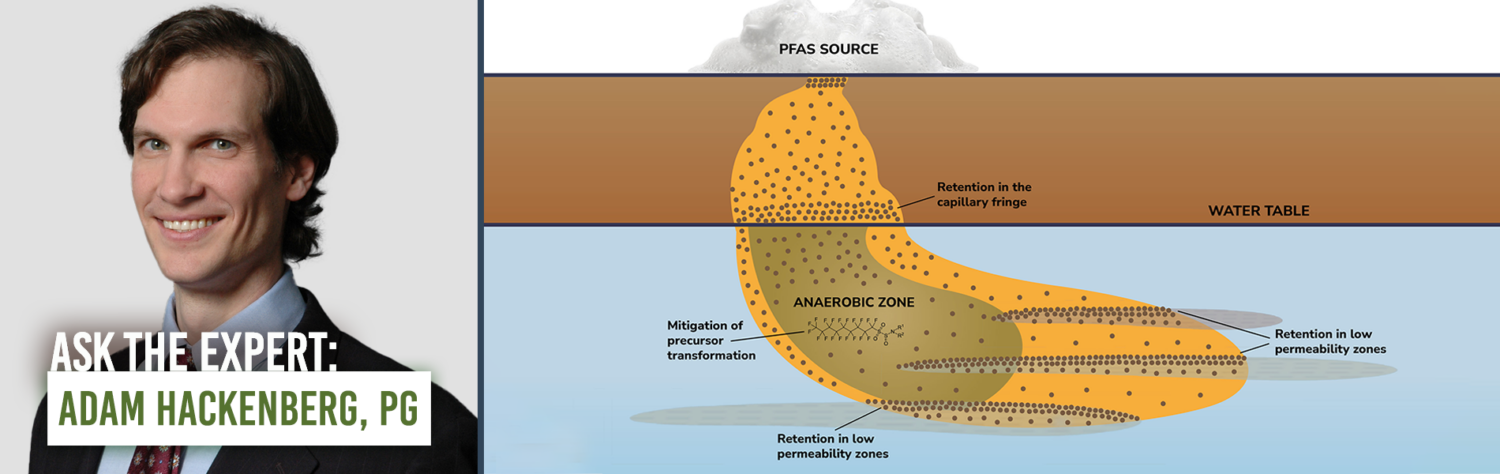
PFAS Monitored Retention (PMR) is a groundwater management approach that uses natural physical and chemical processes. These include sorption to soil and matrix diffusion into low‑permeability zones, and precursor retention to slow the movement of PFAS plumes and reduce peak concentrations. Unlike traditional monitored natural attenuation, which relies heavily on biodegradation, PMR acknowledges that PFAS compounds are highly resistant to biological breakdown. Instead of destroying contaminants, PMR focuses on retention: a stabilization-based strategy that limits plume migration and protects receptors without relying on active treatment systems.
One of the key concepts of PMR is “peak dampening.” This process prevents the development of concentrated, highly mobile plumes in favor of lower-concentration, stable plumes. It does not remove PFAS from the environment, but it can significantly reduce mass discharge to downgradient receptors, enabling more sustainable management and potentially avoiding the need for complex, resource-intensive solutions.
When is PMR an appropriate management strategy, and what is needed to support its use?
PMR is most suitable for mature PFAS plumes when the risk to receptors is low, and a long-term stabilization measure is needed.
When PMR alone is insufficient, PFAS Enhanced Retention (PER) options can be introduced to reduce plume mobility, including the in-situ deployment of adsorbent media and the installation of low-permeability caps to reduce leaching and enhance retention. Under the right circumstances, PMR and PER can be functional, economical, and sustainable alternatives for managing persistent PFAS compounds in groundwater.
Langan’s PFAS experts support the evaluation and application of PMR and PER at sites of varying complexity. The team integrates creative site characterization strategies, plume stability assessments, and geochemical analyses to determine whether PMR is a defensible approach for long-term PFAS plume management. They can also design data collection programs to quantify retention mechanisms, apply advanced modeling tools to evaluate past and predict future plume behavior, and design and implement PER solutions when enhanced strategies are warranted. By combining technical precision with practical implementation experience, Langan helps clients leverage PMR and PER as sustainable, cost‑effective approaches to managing persistent PFAS challenges.
Adam Hackenberg, PG, is a Senior Project Manager with 25 years of diverse environmental experience investigating and remediating environmentally distressed sites under various state programs, CERCLA/Superfund, and RCRA. He distills, interprets, and presents complex datasets to clients, integrating them into conceptual site models to support sound decision-making. He also frequently advises clients regarding chemicals of emerging concern, such as PFAS and 1,4-dioxane, and is active in several related regulatory and technical stakeholder processes.