
PFAS Remediation Challenges: Lessons from the Field
This feature is adapted from episode 3 of our Challenge Accepted podcast about PFAS, which featured a conversation between host Adam Hackenberg and guests Amita Oka, Anna Willett, and Shalene Thomas (Battelle).
Building Better Solutions
Lessons from the Front Lines of PFAS Remediation Innovation
PFAS remediation has become one of the environmental industry’s most significant technical challenges. As regulatory standards continue to evolve and treatment objectives become more stringent, organizations are seeking solutions that deliver reliable results under real-world conditions. Yet success in PFAS treatment is rarely driven by a single technological breakthrough. More often, it is achieved through rigorous testing, sound engineering, and a clear understanding of how technologies perform in the field.
Key Takeaways
- Different PFAS compounds and site conditions make treatment performance difficult to predict using laboratory results alone.
- Pilot projects help teams assess efficiency, reliability, maintenance needs, waste management, and lifecycle costs under real-world conditions.
- Achieving a non-detectable concentration is only one measure of success; residuals, energy use, operational complexity, scalability, and long-term cost also matter.
- Future PFAS remediation programs will rely on emerging treatment approaches, integrated systems, and multidisciplinary expertise.
Why is PFAS Remediation Challenging?
 The science behind PFAS persistence is well understood. What remains challenging is applying treatment technologies effectively across the wide range of real-world site conditions.
Unlike many environmental contaminants, PFAS represent a large family of compounds with varying physical and chemical properties, which makes it difficult to predict responses to treatment. Similarly, results achieved in a controlled laboratory setting do not always translate directly to groundwater, industrial wastewater, landfill leachate, or other complex environmental matrices.
These realities make PFAS remediation fundamentally different from traditional cleanup programs. Success requires more than simply identifying a contaminant and selecting a treatment system. It requires a deep understanding of how site conditions, regulatory objectives, operational constraints, and long-term management goals intersect with available technologies.
How Pilot Projects Help Address PFAS Remediation Challenges
Environmental professionals often encounter technologies that produce impressive laboratory results but have limited field performance data. Pilot studies help bridge that gap by allowing project teams to evaluate technologies under the specific conditions they will face in practice. They also help answer critical questions about treatment efficiency, operational reliability, maintenance requirements, waste stream management, and lifecycle costs before large capital investments take place.
Perhaps most importantly, pilot projects create opportunities for collaboration among technology developers, regulators, consultants, and facility owners. Those collaborations often lead to the practical insights needed to refine technologies and accelerate adoption.
Evaluating PFAS Treatment Beyond “Non-Detect”
Another challenge facing the industry is the pursuit of increasingly ambitious treatment goals. While the desire to achieve the lowest possible concentration is understandable, the conversation has evolved from whether PFAS can be removed to a broader discussion of how treatment performance should be evaluated.
For example, many separation technologies successfully remove PFAS from water but create a concentrated residual stream that still requires management. Similarly, destructive technologies that may effectively break down PFAS compounds should be evaluated for energy demand, byproduct formation, operational complexity, and scalability.
These considerations are driving greater emphasis on lifecycle thinking. Rather than evaluating technologies solely on removal efficiency, organizations are assessing overall system performance, including long-term sustainability, cost, operational requirements, and residual management.
Separating Proven PFAS Solutions from Promising Concepts
The number of PFAS treatment options continues to expand rapidly, though not every emerging solution is ready for full-scale deployment. The most successful PFAS remediation technologies are supported by transparent performance data, independent validation, third-party testing, and demonstrated field experience.
Experienced PFAS practitioners recognize that understanding the details behind performance claims is essential. Details regarding influent conditions, testing protocols, treatment residuals, and operational requirements often reveal more than removal percentages.
The Future of PFAS Treatment
Areas of continued advancement include destruction technologies, in-situ treatment approaches, and integrated treatment systems that combine multiple treatment mechanisms.
At the same time, successful remediation programs will continue to rely on multidisciplinary expertise. Chemists, engineers, hydrogeologists, risk assessors, regulatory specialists, and facility operators each play a critical role in developing effective solutions.
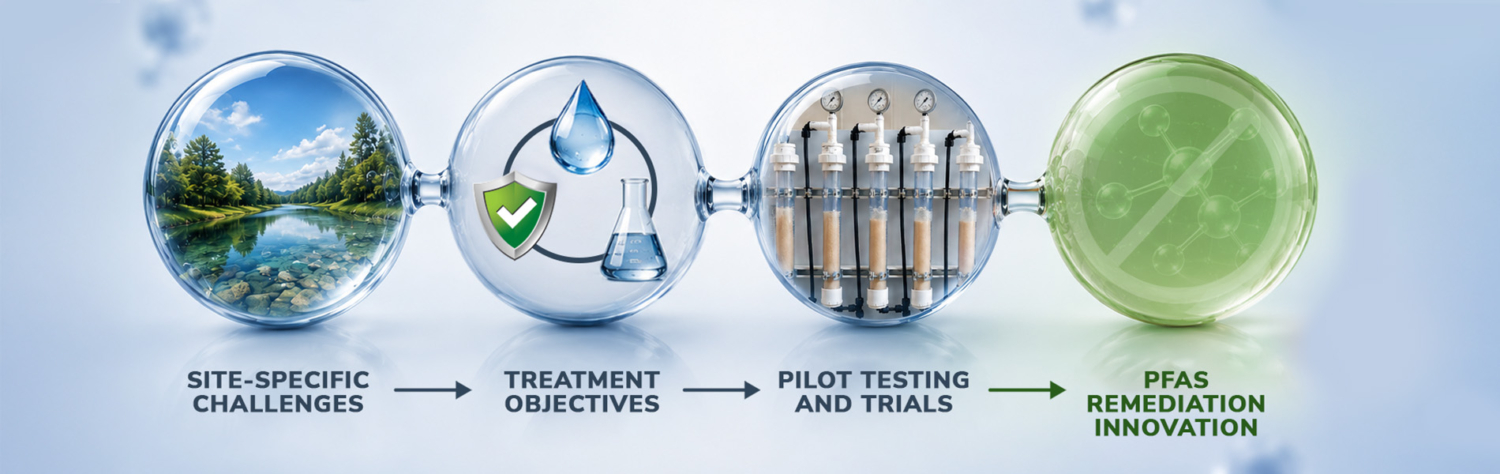
Langan’s experience supporting PFAS investigations, treatment evaluations, pilot studies, and remediation projects has reinforced a consistent lesson: successful outcomes begin with a thorough understanding of site-specific challenges, realistic treatment objectives, and careful evaluation of available technologies.
Amita Oka, PhD, is an environmental scientist with over 15 years of experience, specializing in remedial technology evaluation, engineering design, and full-scale implementation of physical, chemical, and bioremediation alternatives. Her work also focuses on in-situ treatment, treatability testing, and pilot testing of PFAS-impacted media. Located in Langan’s Princeton office, Dr. Oka is actively involved in the Langan Treatability Facility at New Jersey Institute of Technology.
Anna Willett is a Senior Project Manager in Langan’s Arlington, VA, office with over 20 years of experience providing technical support and project management for the clean-up of contaminants in engineered systems and natural environments. She has expertise in PFAS assessment and treatment, chemical and biological processes, water and wastewater treatment, and soil/groundwater remediation.
FAQs on PFAS Remediation Challenges
When should an organization consider a PFAS pilot project?
A pilot project may be appropriate when data is insufficient to predict performance under site-specific conditions, when pretreatment needs are uncertain, or when a proposed system requires evaluation before full-scale investment.
What information is needed to plan a PFAS pilot project?
Planning a PFAS pilot project typically begins with treatment objectives, expected flow rates, water or waste chemistry, operational constraints, and anticipated residual streams. Understanding how these conditions may vary over time is also important when designing the pilot test.
How should PFAS treatment residuals be addressed?
Residual planning should consider what waste streams the treatment process will generate, how PFAS will be concentrated, and what handling, transportation, treatment, or disposal requirements may apply. These considerations should be incorporated before a technology is selected.
Can one treatment technology address every PFAS remediation scenario?
No single technology is likely to perform equally well across all PFAS compounds, environmental matrices, concentration ranges, and project objectives. Some projects may require pretreatment or an integrated treatment system that combines multiple mechanisms.