
PFAS Source Attribution and Environmental Forensics
Unlocking Chemistry
Transforming PFAS Analytical Results into Defensible Source Attribution

PFAS are increasingly common in environmental liability matters, and simple detection is no longer sufficient. For attorneys, land redevelopers, and insurance risk managers, the critical—and often costly—question is not whether PFAS are present, but where they originated and who bears responsibility. Answering those questions requires environmental forensics to distinguish separate plumes and support defensible source attribution. Langan is at the forefront of untangling PFAS datasets to demystify sources and provide clear decision paths on remediation and redevelopment projects.
Key Takeaways
— Environmental forensics can help differentiate PFAS sources, support source attribution, and inform liability evaluations.
— Historical AFFF formulations and industry-specific PFAS compounds create chemical fingerprints that can help identify potential contamination sources.
— EPA Method 1633/1633A data can provide valuable forensic insight without requiring non-standard analytical testing.
— Advanced analytics and data visualization help transform complex PFAS results into defensible, decision-ready information.
Tracking the Lineage: AFFF Generations and Industrial Signatures
Aqueous film-forming foam (AFFF) releases are a major source of PFAS in the environment, and the forensic journey often begins with the historical chemistry of AFFF. This is because different types of AFFF were produced to meet firefighting specifications, rather than formulated to contain a specific PFAS mixture. Before 2002, AFFF was formulated using electrochemical fluorination (ECF), exhibiting footprints dominated by perfluorooctane sulfonate (PFOS), with a distinctive mix of linear and branched isomers of long-chain perfluoroalkyl sulfonic acids (PFSA). More modern fluorotelomer-based formulations exhibit predominantly linear chains of precursor compounds that vary based on the manufacturer, batch, era, and precursor degradation. Even within ECF foams, the ratio of PFOS to perfluorohexane sulfonate shifts by manufacturing era and lot, helping to distinguish legacy sources.

The presence of certain PFAS compounds in a plume may indicate a release from a particular industrial sector:
- Chrome & metal plating: Starting in the 1990s, PFOS was widely used for mist suppression, before transitioning to 6:2 fluorotelomer sulfonate (6:2 FTS) in the 2010s.
- Fluoropolymer & non-stick manufacturing: Long-chain perfluoroalkyl carboxylic acids (PFCA), such as PFOA and PFNA, dominate footprints, while ether-PFAS replacements like GenX and ADONA appear in more modern footprints.
- Textiles, carpets, & leather treatments: Large PFAS compounds are the source compounds that biotransform in the environment to predictable distributions of PFCAs.
- Semiconductor & electronics manufacturing: Continued use of specialized perfluorobutane sulfonate (PFBS) and legacy PFOS in manufacturing and releases exhibit a near-absence of long-chain carboxylates.
Analyzed together, these generational and industry-specific patterns form chemical fingerprints that differentiate active manufacturing releases from legacy airport or municipal runoff.
Leveraging EPA Method 1633/1633A: Forensic Value in Compliance Data
The standardization of EPA Method 1633 and its update, Method 1633A, is a forensic asset. Created for compliance with the Clean Water Act and Federal CERCLA/States site remediation investigations, the multimedia method’s 40-compound analyte list can be reported with linear and branched isomer concentrations for several PFAS compounds. This generates data that can be evaluated forensically for source identification and differentiation. Langan’s PFAS experts can extract this forensic-grade insight from regulatory data, helping clients to delineate plume boundaries without commissioning costly, non-standard testing.
From Noise to Signal: Multivariate Statistics and PCA
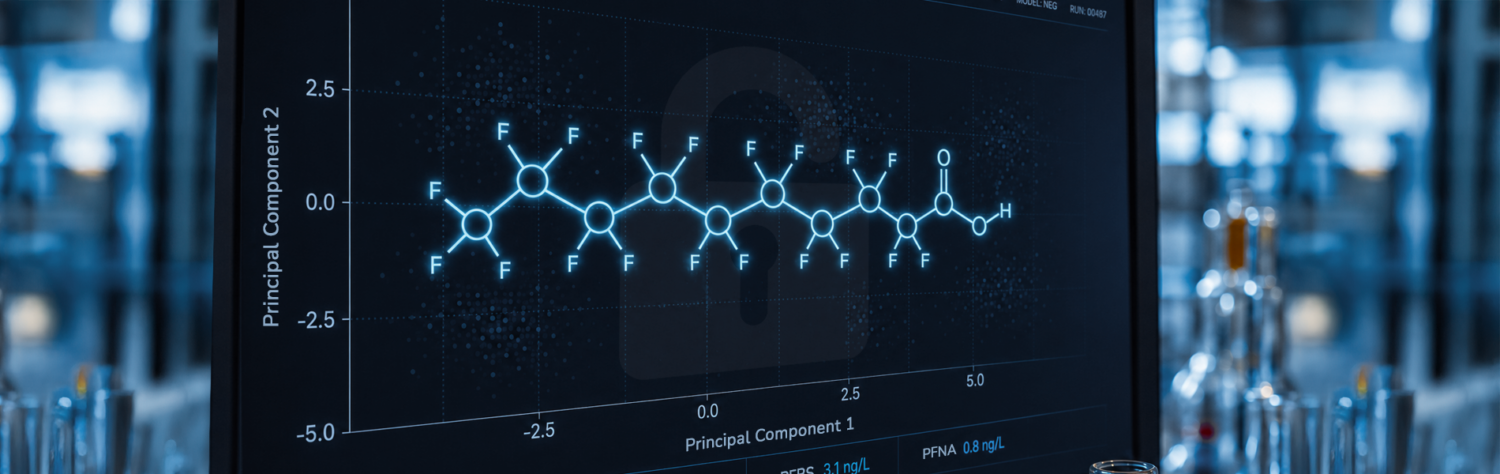
With dozens of compounds measured across various locations, raw data quickly becomes overwhelming. Multivariate statistics—chiefly Principal Component Analysis (PCA)—act as a mathematical lens, reducing complexity and mapping PFAS concentration variances into distinct clusters, or “signatures.” This enables Langan’s PFAS team to visually and statistically demonstrate whether a plume originates on-site or reflects an overlapping contribution from an upgradient, off-site neighbor.

Visual Storytelling: Turning Data into Strategic Intelligence
PFAS results are not merely numbers in a laboratory report—they inform liability, plume delineation, and defensible remedial strategies. Yet a raw, 40-compound table is too dense to facilitate timely decisions. Effective visualization translates complex chemistry into intuitive narratives, structured around three pillars: compound-type differentiation, carbon-chain-length patterns, and data storytelling. With environmental EQuIS databases and workflows, Langan applies compound-visualization practices while tailoring outputs to support project needs and communication with regulatory audiences.
Turning PFAS Data into Defensible Decisions
By integrating diagnostic ratios, industry-specific tracer compounds, and advanced statistical tools, teams can distinguish discrete plumes, evaluate potential off-site contributions, and characterize PFAS transport within a Conceptual Site Model (CSM). PFAS CSMs should account for ambient anthropogenic background conditions while also aligning with site-specific hydrogeologic pathways, fate-and-transport mechanisms, and chemical evolution with distance from the source.
Langan presents this chemistry through clear, visual storytelling, empowering clients to make defensible decisions that manage contaminated media, refine remediation boundaries, and reduce significant legal and financial risk.
Adam Goldberg is a Senior Project Manager and Hydrogeologist in Langan’s Philadelphia office, with expertise in environmental investigations and innovative environmental technologies. He specializes in PFAS investigation strategy and forensics, site remediation, brownfield redevelopment, property due diligence, and applied technologies. Goldberg serves as an industry expert on the Interstate Technology and Regulatory Council’s 1,4-Dioxane committee and PFAS committees.
Jeff Ramey is the leader of Langan’s operations throughout Wisconsin and a PFAS subject-matter expert with over 20 years of experience in the environmental industry. Throughout his career, he has managed and supported PFAS site characterization and investigation, remediation, analytical forensics, strategy, and risk management for clients dealing with established, emerging, and/or absent regulations. Ramey regularly presents at technical conferences and for trade organizations and stakeholder groups about emerging contaminant regulations and enforcement.
PFAS Source Attribution FAQs
Why is PFAS source attribution important?
PFAS source attribution helps determine where contamination originated and whether multiple sources may be contributing to environmental impacts. Understanding source contributions can support liability evaluations, remediation planning, regulatory discussions, and environmental due diligence decisions, particularly when PFAS contamination affects multiple properties or stakeholders.
Can multiple PFAS sources contribute to the same plume?
Yes. PFAS contamination can originate from multiple sources that impact the same groundwater system, creating a commingled plume. In these situations, environmental forensics can help evaluate source contributions, distinguish overlapping PFAS signatures, and support defensible source attribution.
What types of information are used in PFAS source attribution?
PFAS source attribution may incorporate analytical results, chemical fingerprints, diagnostic compound ratios, historical site information, groundwater flow data, and statistical analyses such as Principal Component Analysis (PCA). Evaluating multiple lines of evidence helps investigators develop a more complete understanding of potential PFAS sources and plume behavior.